2014 TEN OUTSTANDING LOCAL GOVERNANCE PROGRAMS
Dipolog City
Cities offer economic opportunities that attract people from the poor barrios. Many of them end up occupying public vacant lands which are soon over- crowded over time. In the case of Dipolog City, the informal settlers occupied the coastlines with their makeshift homes. Bereft of proper sanitation and proper waste management, these areas were soon filled with so much contaminants that the city government had to ban swimming and other water recreation activities along the beaches in 1998.
In 1999, the LGU began to plan the rehabilitation of the public areas along the coast of Barangays Central and Miputak. Their aim was to provide decent housing and improve the well-being of the informal settlers, restore and improve the natural ambiance of the environment, and minimize erosion in the coastal area. With these in mind, they embarked on a project, called “Construction of Sea Wall and Foreshore Development” or simply the “Dipolog Boulevard.”
The project would entail the transformation of the degraded areas into a venue for economic activities and recreation. It would also involve the development of low-cost housing subdivisions for displaced families and the provision of alter- native sources of livelihood to the displaced families. In May 2000, the City Council passed a resolution establishing the guidelines and providing the blueprint for the resettlement of informal settlers.
With the help of the NGOs, the LGU carried out social preparation activities to elicit the cooperation of the informal settlers. There was initial resistance but they soon cooperated after they saw that the relocation sites contained all the required infrastructure amenities (such as road networks, water and electricity, toilet facilities, drainage systems and docking area for fishing boats) and that they will be provided with livelihood opportunities or ample compensation and rehabilitation assistance. Some of the informal settlers were even employed in the construction of the Dipolog Boulevard.
Completion of the core houses at the relocation site was the full responsibility of the settlers. This process, plus the awarding of stewardship contracts, cultivated in them a sense of ownership and belongingness in the resettlement area. This sense of belongingness was reinforced when they were employed in the construction of the Dipolog Boulevard.
About 599 families or 2,995 informal settlers were provided with decent housing. An elementary school was opened to give the children easy access to primary education; the school has 435 pupils, composed mostly of the resettled children. A cooperative was organized and it is now managing a sari-sari store and a bakery.

Linkages with the national government and other agencies helped the city generate a total funding assistance of PhP218.6 million for the project from the World Bank, National Housing Authority, Department of Public Works and Highways, and the Department of Tourism. It also obtained PhP99.35 million of funding commitments for 2015.
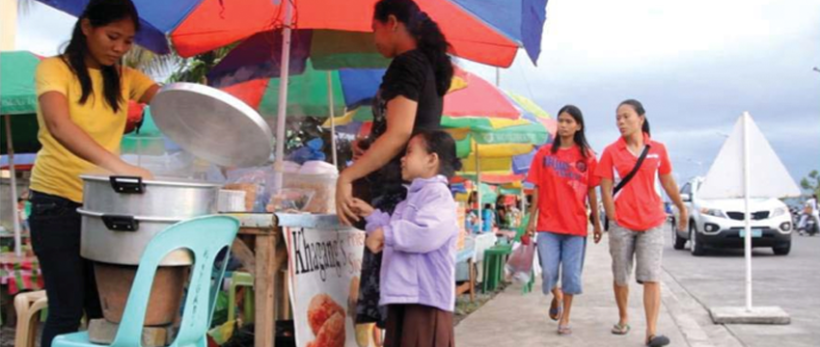
At the Dipolog Boulevard, a large Commercial Complex was constructed. This currently houses 15 establishments with a combined capitalization of PhP4.65 million. Along designated areas in the boulevard, 40 marginal families are engaged in vending food and beverages; they earn between PhP6,000 to PhP60,000 per month. The stall rental fees, meanwhile, provide the city government with a monthly in- come of PhP393,000.
The quality of the coastal environment was eventually restored. In 2013, the shore of the Dipolog Boulevard became a nesting area for sea turtles; 185 baby sea turtles or hatchlings were recently released by the city government to the sea.
CONTACT:
Mayor Evelyn T. Uy
Tel. Nos. (065) 212 2902/8269
Email: evelyntuy@mamamayani.org